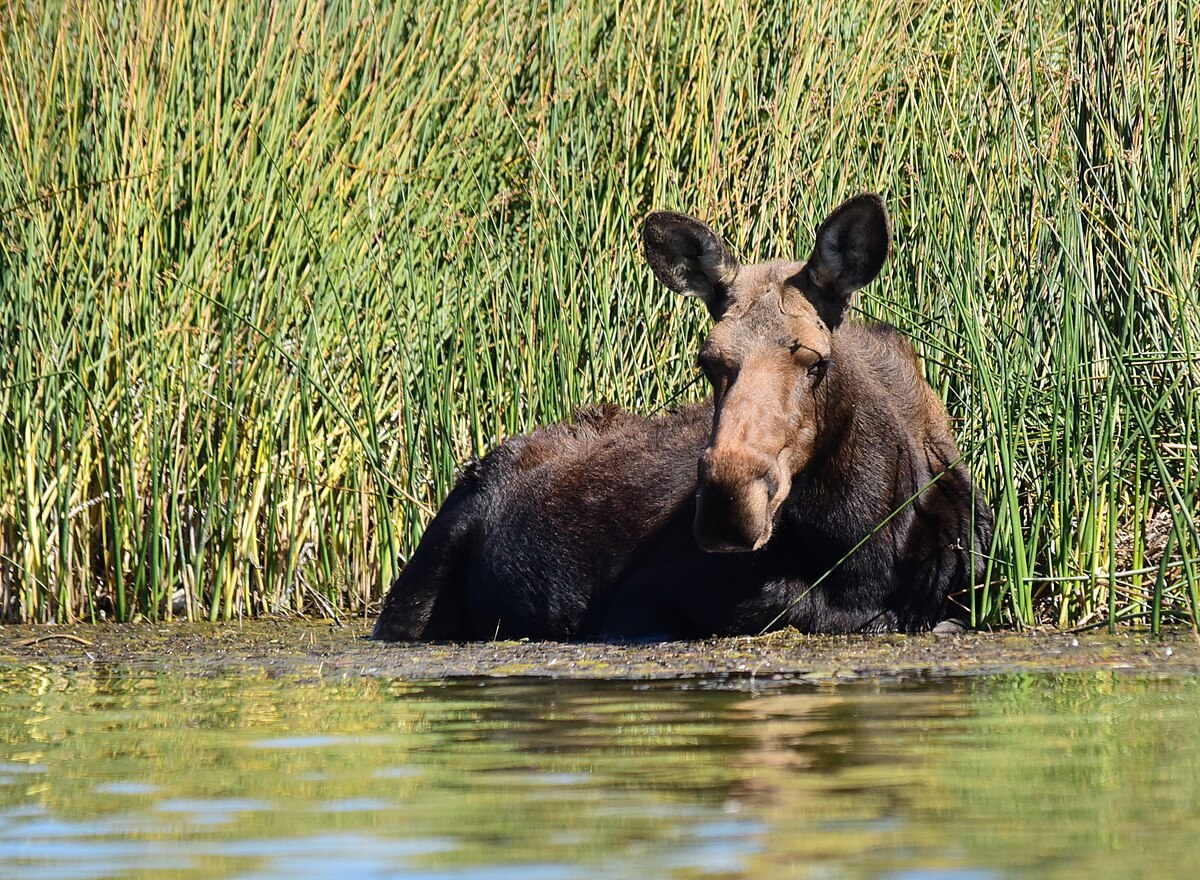
Yes, a moose can be active in rain. A tracking study in Minnesota found that its collared moose were more likely to forage or travel during precipitation in spring and summer. The effect was modest, though: rain by itself cannot tell you whether a particular moose will be moving when you visit.
What does the research show?
Mark Ditmer and colleagues tracked 13 moose in and around Voyageurs National Park between 2010 and 2012. GPS collars and movement sensors helped the researchers classify behaviour as resting, foraging or travelling. In spring and summer, precipitation coincided with a greater chance of the latter two behaviours. The researchers also found that rain and wind had relatively small effects compared with other weather and landscape factors.
That is a finding about a small group of moose in one part of North America, across seasons. It is not a promise that moose emerge whenever a shower starts, nor proof that rain itself made each animal move. A moose you see in rain could be feeding, travelling or resting.
moose were more likely to be active (i.e., traveling or foraging) during precipitation events especially during spring and summer
Does heavy rain make moose hide?
There is no reliable rule in this study that moose shelter through every downpour. It does not establish a threshold at which rain becomes too heavy for them to move, or explain an individual moose’s choice by poor visibility, hunger, predators or mating. Those claims need different evidence. Watch the animal and its surroundings rather than assuming its next move from the rain forecast.
What matters besides rain?
In the Minnesota study, season, temperature and habitat also mattered. The researchers found less travel and more rest in warmer conditions, especially during spring and summer. That makes a simple “rainy versus dry” prediction misleading: a cool, wet day, a warm shower and an animal in different cover are not interchangeable situations.
Snowstorms are a separate question. This rain finding does not tell us how a moose will behave in a blizzard or severe storm.
Watching a moose safely in wet weather
Use binoculars or a camera zoom instead of approaching. The U.S. National Park Service’s Alaska guidance says to stay at least 25 yards from a moose, and to leave more room for a cow with a calf. Follow any stricter rule at the place you are visiting. If your presence changes the animal’s behaviour, move farther away.
If you spot a moose from a road, pull completely clear of traffic only where it is safe to do so. If there is no safe place to stop, drive on. Rain can make it harder for you to see and stop safely; it is no reason to get closer to the animal.
If a moose is close
Stop where you are and give it room. Do not approach for a photograph. Back away if it reacts to you; allow extra distance when a calf is nearby.
So, are moose more active in rain?
They can be. One Minnesota study found a modest increase in foraging and travel during spring and summer precipitation, but it cannot predict an individual encounter. Expect variation, watch from a distance and give any moose an easy route away.
Sources & further reading
Ditmer, M. A. et al., “Moose at their bioclimatic edge alter their behavior based on weather, landscape, and predators,” Current Zoology, published 28 July 2017 (2018 issue), https://pmc.ncbi.nlm.nih.gov/articles/PMC6084617/ — checked 27 September 2026.
U.S. National Park Service, “Wildlife Safety — Alaska,” updated 12 April 2022, https://www.nps.gov/locations/alaska/wildlife-safety.htm — checked 27 September 2026.