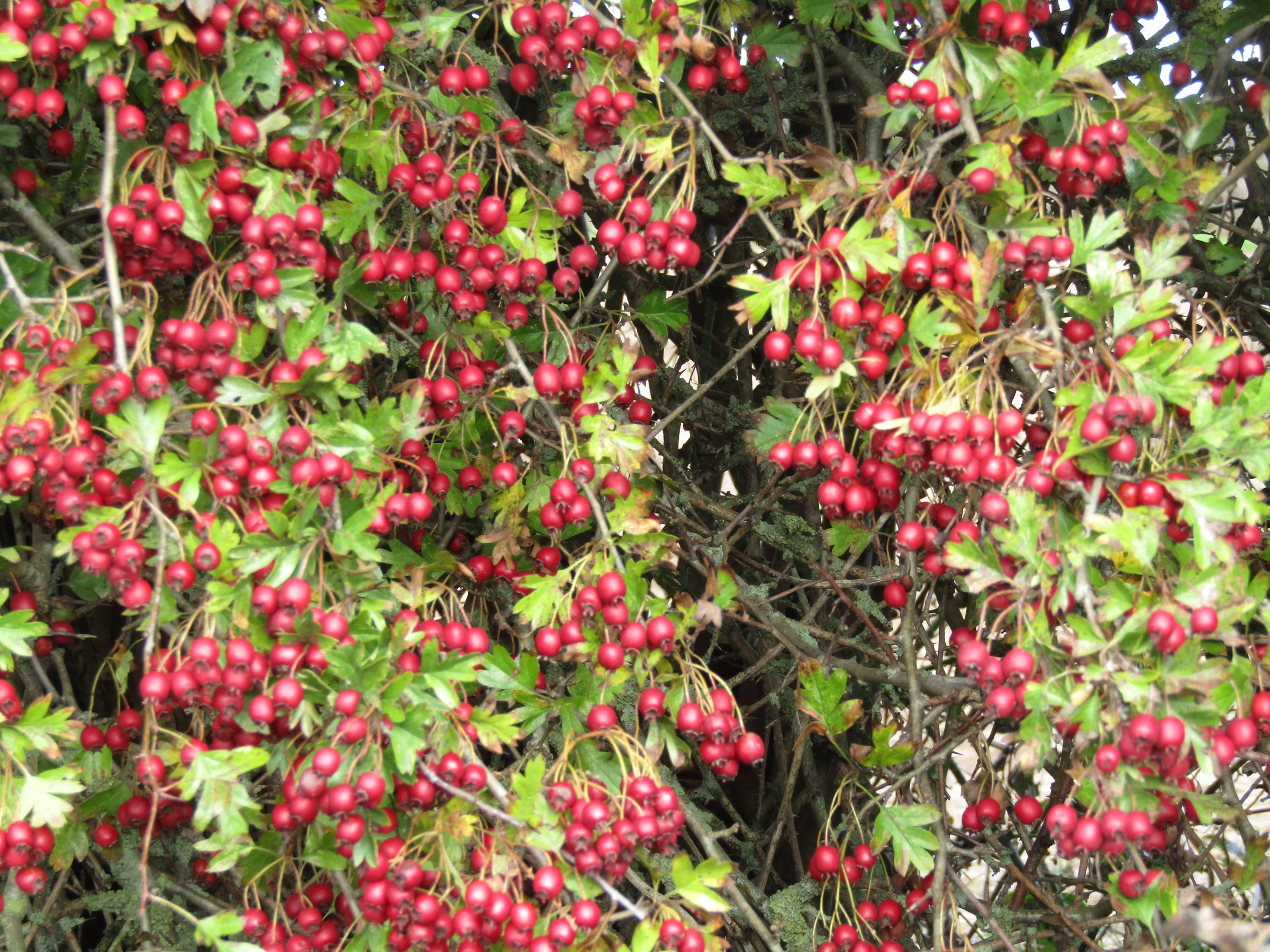

On a cold morning, a blackbird may work through a shrub whose berries you barely noticed in summer. The most useful choice for a garden is not a single “best” berry bush: it is one that fits the space, fruits reliably and can be left long enough for birds to use. Hawthorn, guelder rose, holly and mature ivy offer different sizes, seasons and kinds of cover.
Start with the space, then the fruit
The British Trust for Ornithology's fruiting-plant guide lists native and introduced plants, with notes on the birds and seasons associated with them. Before buying, allow for the plant's mature width, roots and thorns as well as its berries. A hedge at the back of a garden can do a different job from a shrub beside a narrow path.
Hawthorn suits a boundary with room for a thorny hedge or small tree. Its spring flowers are followed by haws from late summer; some remain into winter if birds have not taken them. BTO links hawthorn with winter thrushes, including blackbirds, redwings, fieldfares and mistle thrushes. It prefers ground that is not waterlogged.
Guelder rose offers a softer, deciduous shrub for a border with some room. Red fruits appear around September or early October, and BTO particularly notes bullfinches and mistle thrushes. It suits moist but not waterlogged ground. The smaller ‘Compactum’ is an option when a full-sized shrub will not fit, though it still needs growing space. BTO cautions that raw guelder-rose fruit can cause vomiting in people, so think about access by small children.
Holly brings evergreen shelter and berries later in the year. Berrying depends on the plant you buy: most hollies have separate male and female plants, so a female needs a male nearby. Some cultivars are self-fertile. Check the label carefully; names such as ‘Golden King’ and ‘Silver Queen’ do not reliably tell you the plant's sex. The RHS holly guide explains the choices.
Mature ivy can make a boundary productive without another freestanding shrub. Its flowers provide late nectar, and its dark berries ripen through winter. Ivy clipped continually in its juvenile climbing stage may never develop the flowering, berrying adult growth. Let a manageable section mature where it will not block a path, gutter or window; the RHS ivy guide describes this change in growth.
Before you buy a berrying plant
Check four things on the label or plant profile: mature spread, soil moisture, whether it flowers and fruits, and whether it needs a pollinating partner. Put a thorny hawthorn away from a tight route. For holly, confirm that you are buying a berrying female or a self-fertile cultivar rather than choosing by the cultivar's name.
“Many birds rely on berries and fruits in autumn and winter”
Let the shrub keep its crop
Flowers must remain on the plant if berries are to follow. Repeated close clipping can remove flowering growth; heavy autumn tidying can take the crop just as it becomes useful. Learn when your chosen species flowers, prune only as much as the space requires, and check carefully for active nests before any work. Leave some cover beneath and around the shrub rather than making every edge bare.
If the berries vanish early, that does not mean the plant failed. BTO notes that some fruits persist into winter while others are taken soon after ripening. Watch what happens in your own garden over a season before deciding whether you need another plant to extend the supply. Natural fruit is one part of a bird-friendly garden alongside cover, water and suitable places to forage.
A note on introduced berry shrubs
Firethorn (pyracantha) can feed urban blackbirds, but it is an introduced plant. BTO also flags several cotoneasters as invasive or legally restricted in parts of the UK. Do not buy a plant simply because it has attractive berries or a “wildlife” label: check the exact species and local status first. Native hawthorn or guelder rose is often a clearer starting point where either suits the site.
Sources & further reading
- British Trust for Ornithology. “Plants with fruits and berries for birds”, undated. Checked 1 October 2026 — Read source
- Royal Horticultural Society. “How to grow hollies”, undated. Checked 1 October 2026 — Read source
- Royal Horticultural Society. “How to grow ivy”, undated. Checked 1 October 2026 — Read source