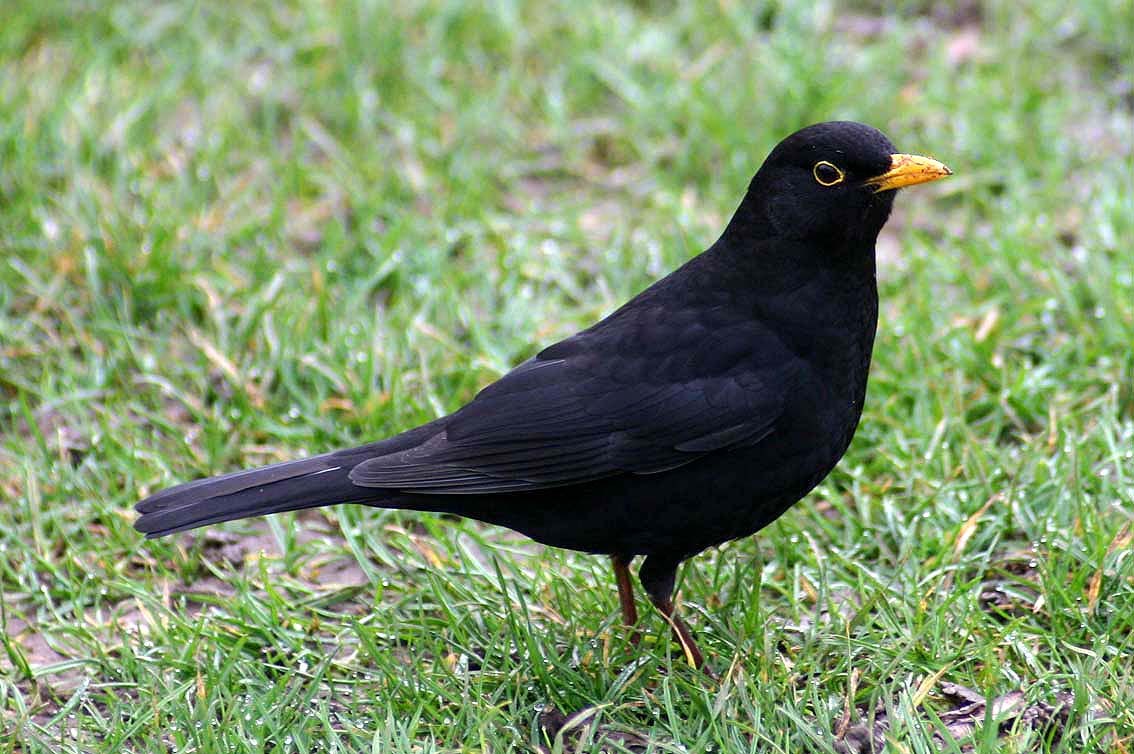
Yes, a blackbird may use the same UK garden across seasons and even return in later years. British Trust for Ornithology (BTO) observations describe urban and suburban birds holding familiar breeding territories year after year. But seeing a blackbird in the same place does not prove it is the same individual.
Do blackbirds stay or return each year?
Many British blackbirds are resident. A garden can form part of a territory that an adult uses through winter as well as the breeding season. The male and female may use different parts of that territory in winter, so a bird can seem to have vanished while it is still nearby. Territory use is a pattern, not a promise that every bird survives or revisits the same patch.
The birds using these suburban and urban landscapes tend to remain on their territories throughout the year
Can you tell whether it is the same bird?
A male's black feathers and yellow bill, or a female's brown plumage, identify the kind of blackbird rather than the individual. The BTO explains that a uniquely coded ring lets researchers recognise a bird on another occasion. A clear, lasting individual mark can help you compare photographs, but an unmarked bird that looks familiar is only a possibility, not proof.
Keep a simple sighting record
Take a photograph from a distance, note the date and location, and compare any clear markings with earlier photographs. If you cannot identify a unique mark or readable ring, say that blackbirds keep visiting rather than claiming the same bird has returned. Do not approach a nest to make the comparison.
Why might winter visitors be different?
The RSPB says most UK blackbirds are resident, some move south, and many birds from northern Europe arrive here in autumn. A winter blackbird in your garden might be a local resident or a visitor. Its presence in January therefore tells you little about which bird nested nearby in spring.
Will it use the same nest?
Returning to an area is different from reusing a nest. The RSPB describes females building a new nest for each clutch, even when they raise more than one brood in a season. An old nest is useful to notice, but it does not identify next year's occupants.
What makes a garden useful to blackbirds?
The BTO describes a mix of shrubby cover, taller trees and open ground such as lawns or flowerbeds where blackbirds can forage. Keeping some shelter alongside accessible ground makes a garden suitable for visits. It cannot guarantee that a particular bird will come back.
Related reading: Why Do Blackbirds Fledge on the Ground? What to Do; How Long Do Wild Birds Live? Lifespans and Records.
Sources & further reading
Mike Toms, British Trust for Ornithology, “Blackbird”, Bird Table, Winter 2013 (checked 25 September 2026): https://www.bto.org/sites/default/files/shared_documents/gbw/associated_files/bird-table-76-blackbird-species-focus.pdf
RSPB, “Blackbird” (checked 25 September 2026): https://www.rspb.org.uk/birds-and-wildlife/blackbird
British Trust for Ornithology, “Why colour mark birds?” (checked 25 September 2026): https://www.bto.org/get-involved/volunteer/projects/bird-ringing-scheme/about-ringing/why-colour-mark-birds