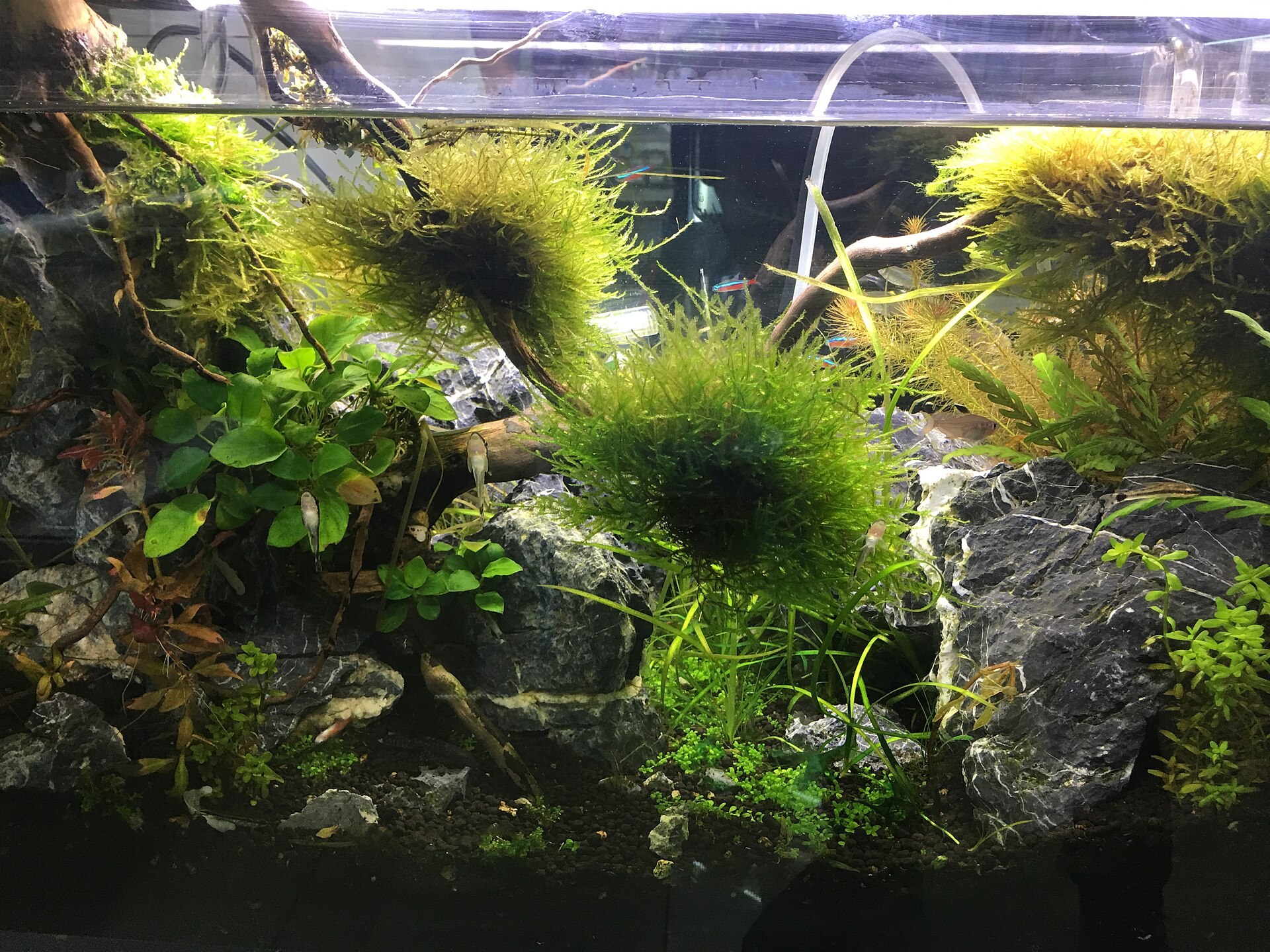
There is no reliable calculation that tells you how many fish every aquarium can hold. For a home freshwater tank, start with the adult size and needs of the species, the usable swimming space, and whether the filter can keep ammonia and nitrite at zero as you add fish. The right number can be lower than a stocking calculator suggests. This guide is for freshwater aquariums; marine tanks need their own species-specific plan.
Why does the “one inch of fish per gallon” rule fail?
A length-only rule treats a slim fish and a deep-bodied fish as if they place the same demands on a tank. It also misses adult growth, swimming room, territorial behaviour, social grouping, filtration and maintenance. The RSPCA publishes water-volume-per-length figures for tropical fish and goldfish, but expressly calls them guidelines because water quality depends on many other factors. Do not use a centimetres-per-litre figure, a surface-area figure or a filter-flow rating as permission to fill a tank to a calculated maximum.
Imagine two tanks both labelled 100 litres. One proposed fish needs room to swim with a shoal; another may grow deep-bodied and defend a territory. Their needs lead to different stocking plans even though the tanks hold the same volume. This is an illustration, not a recommended count for either fish.
How do you plan a sensible stocking level?
Choose the species first. Check each fish's adult size, preferred water conditions, swimming needs and whether it needs companions or its own territory. The Ornamental Aquatic Trade Association (OATA) notes that some species shoal while others are territorial or incompatible.
Match the whole aquarium to those fish. Compare its length, width and swimming room with the species' adult needs. Decorations and plants provide useful cover but occupy space; the tank's advertised capacity alone cannot settle the question. Ask an experienced aquatic retailer or fish vet to assess a proposed mix before buying it.
Establish the biological filter before stocking. In a new aquarium, fishless cycling lets beneficial bacteria develop without exposing fish to the early ammonia and nitrite rise. Test the water; the RSPCA advises adding fish only after both have risen and returned to zero. Follow a reputable fishless-cycling method for your equipment rather than adding fish after a fixed number of days.
Add fish gradually and retest. Allow the filter to adjust to a greater waste load, but do not interpret “gradually” as keeping a shoaling fish alone. Ask an experienced aquatic retailer or fish vet how to introduce an appropriate group for the species and tank. OATA advises testing more often when adding fish and keeping ammonia and nitrite at zero.
“Overstocking or stocking your aquarium too quickly can result in ‘new tank syndrome’.”
What should you check after adding fish?
Test ammonia and nitrite, observe whether fish can swim and feed without persistent chasing or crowding, and keep up suitable partial water changes. OATA lists zero mg per litre for both ammonia and nitrite in home freshwater aquaria and recommends regular testing, with more frequent checks while a tank is new or its stocking changes. Record the results and do not add more fish if either reading rises. Clear-looking water is not proof that it is safe.
Act if ammonia or nitrite rises.
Stop adding fish and make a prompt partial water change using dechlorinated water at a suitable temperature. The RSPCA advises changing half the water daily and retesting until these readings improve. Check the filter and feeding, and seek help from an aquatic specialist if the readings do not fall or fish seem unwell. Do not wash the filter media under a tap.
The Merck Veterinary Manual explains why water tests and fish behaviour both matter: an aquarium's capacity depends on filtration and the territory available to its fish. If fish are repeatedly being chased, cannot use the tank normally, or the water cannot remain safe with routine care, revise the stocking plan. A larger suitable tank or responsible rehoming may be needed.
Sources & further reading
RSPCA, “Choosing an Aquarium for Pet Fish” (undated guidance): https://www.rspca.org.uk/adviceandwelfare/pets/fish/environment
Ornamental Aquatic Trade Association, “How to set up and look after a freshwater tank / aquarium” (undated care sheet): https://ornamentalfish.org/what-we-do/advice-information/care-sheets/caresheets-tropical-freshwater-fish/how-to-set-up-and-look-after-a-freshwater-tank-aquarium/
Merck Veterinary Manual, “Providing a Home for Fish” (online veterinary guidance): https://www.merckvetmanual.com/all-other-pets/fish/providing-a-home-for-fish
Sources checked 25 September 2026.