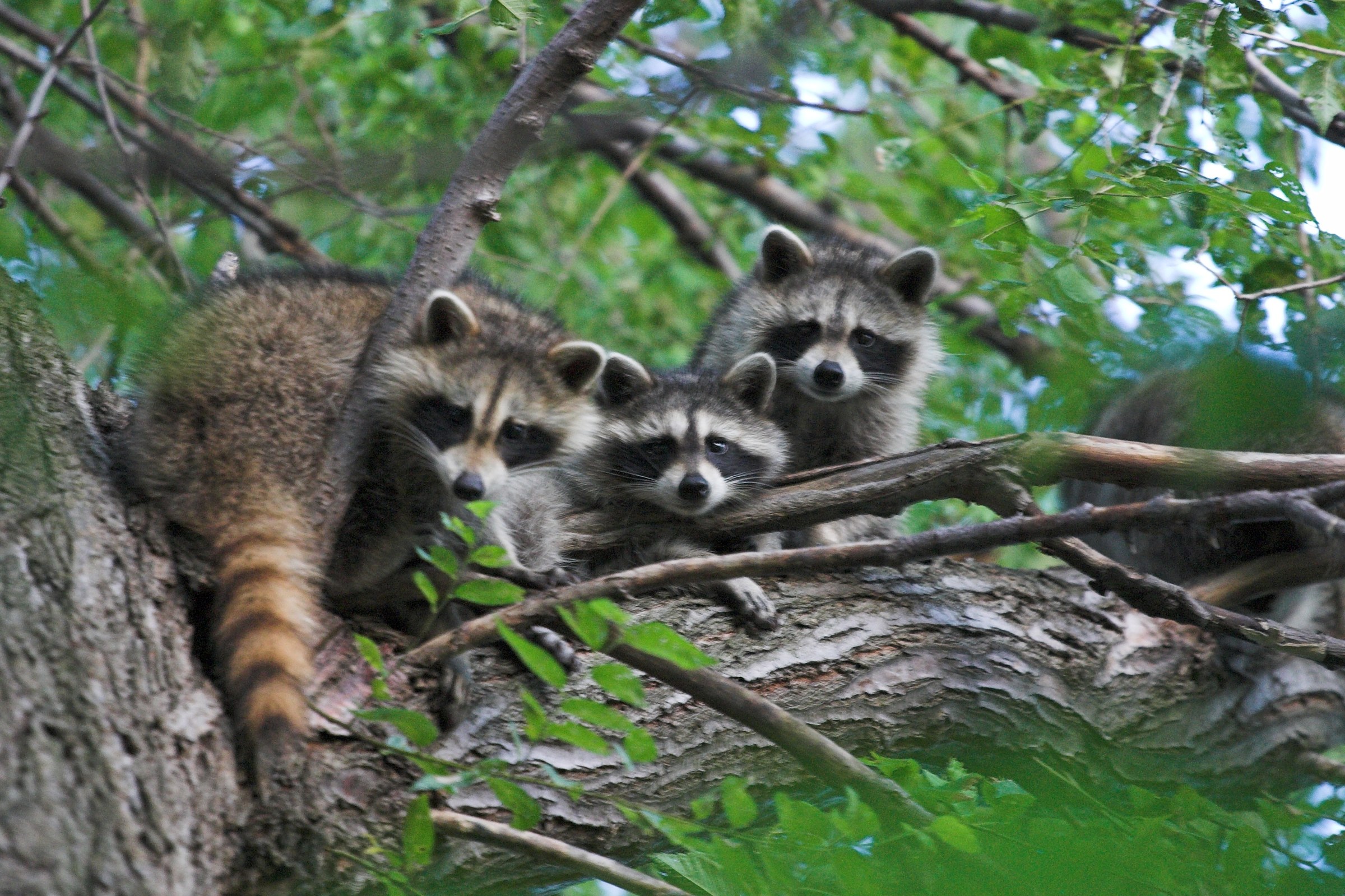
If you hear raccoons scuffling in a tree, a mother defending young or males competing during the mating season are two possible explanations. Raccoons climb and rest in trees, and hollows can serve as dens. The setting alone cannot tell you what started a particular encounter.
What can cause a clash?
Young nearby: The Pennsylvania Game Commission notes that females with young can fight fiercely. If kits are visible near a hollow, defence of young is plausible, though you cannot confirm it from a brief view.
Mating-season competition: A study of raccoons in southern Texas found that overt conflict among males affected access to mates, and male wounds increased during the mating season. That is another documented reason raccoons may fight, though the study did not establish why any one pair met in a tree.
Wounding among males increased during the mating season
Why in a tree?
Raccoons are capable climbers and often rest above ground. Tree hollows can also shelter young. A confrontation may therefore unfold among branches simply because the animals are already there; seeing the tree does not prove that they are defending a den.
Is the noise proof of a fight?
No. Raccoons bark, hiss and scream, so calls alone do not show that one has been hurt. Grappling or biting shows physical contact, but even then a short sighting will rarely reveal what caused it. A fight also does not mean that either animal has rabies.
What to do if you see them clashing
Keep your distance and bring children and pets inside. Do not climb the tree, try to separate the raccoons or attempt to catch one. If an animal appears badly injured or behaves strangely, contact local animal control or a wildlife professional.
If someone is bitten or scratched
Wash the wound immediately with warm, soapy water and seek prompt medical advice about infection and possible rabies exposure. The US Centers for Disease Control and Prevention advises keeping clear of wildlife and speaking with a healthcare provider after a bite or scratch. If a pet has fought with a raccoon, contact your vet promptly.
Sources & further reading
Pennsylvania Game Commission, Raccoons (checked 25 September 2026): https://www.pa.gov/agencies/pgc/wildlife/discover-pa-wildlife/raccoon
Gehrt and Fritzell, Behavioural aspects of the raccoon mating system: determinants of consortship success, Animal Behaviour 57 (1999), 593–601 (checked 25 September 2026): https://www.sciencedirect.com/science/article/pii/S0003347298910375
US Centers for Disease Control and Prevention, Wildlife (15 June 2026; checked 25 September 2026): https://www.cdc.gov/healthy-pets/about/wildlife.html