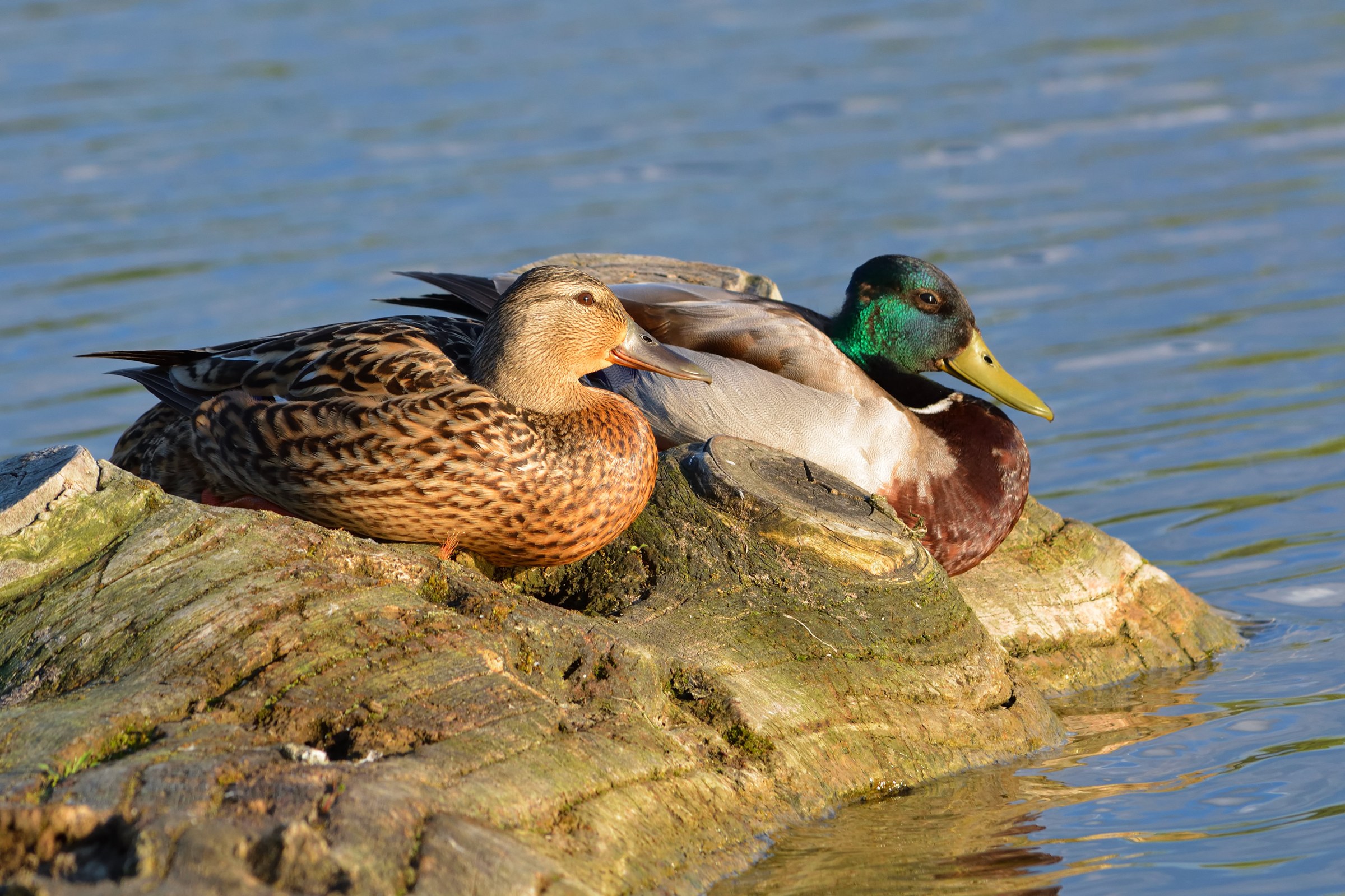
Mallards can detect some light after sunset, but they cannot see in complete darkness. A small vision study found that natural light on several kinds of night was above the level its mallards could detect. That does not mean they see fine detail as well as they do by day. Mallards are not colourblind either: their retinas have four kinds of single cone with different colour sensitivities. This article uses mallards as its example; other ducks may differ.
Lead photograph: a pair of mallards in evening light, photographed by Enoch Leung, CC BY-SA 2.0.
.jpg)
Can mallards see after sunset?
Night is rarely the same as total darkness. Moonlight, stars and nearby lights change how much a bird can see. In a study measuring the low-light threshold of four mallards, the researchers found that light under several natural night conditions exceeded the birds’ detection threshold. This supports some vision after dark; it does not establish a distance at which a mallard can recognise a predator or find food on a particular night.
The mallards' scotopic visual threshold is exceeded by the natural illumination present under several nocturnal conditions.
If there is no light at all, there is nothing for the eye to detect. As light fades, colour and fine detail are harder to judge. The study measured sensitivity, not a complete picture of what a duck experiences while moving around a pond.
Are mallards colourblind?
No. An examination of mallard retinal cells found four types of single cone with visual pigments most sensitive at different wavelengths, including one in the violet part of the spectrum. That is the basis for describing mallard colour vision as four-channel, or tetrachromatic.
Four cone types do not mean that every colour looks brighter to a duck than to a person. Nor does this study tell us exactly how a mallard experiences a named shade such as pink. It shows the eye has more spectral channels than the three used in typical human colour vision. Colour vision depends on enough light; the night-time sensitivity study concerns dim-light detection, not reliable colour discrimination in the dark.
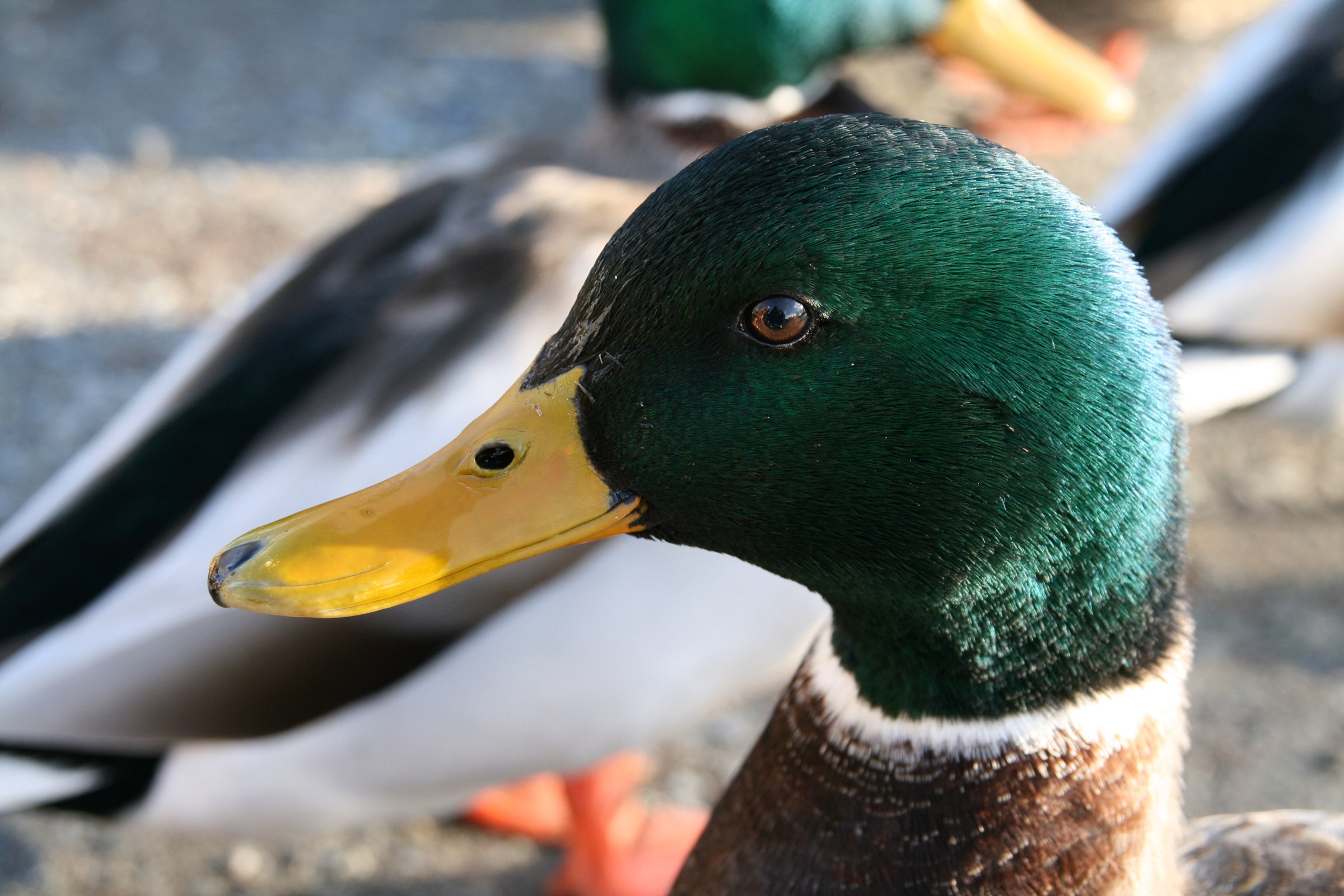


How do ducks find food when visibility is poor?
Vision is only part of feeding. A study of the touch-sensitive bill in domestic ducks found specialised receptors that respond to contact. These birds can use their bills to locate edible material in muddy water without seeing each item. This helps explain how a duck can forage when the water is hard to see through, but it is not evidence of sight in pitch darkness or a measured night-vision ability in every duck species.
What should you take from a duck seen at night?
A mallard moving or feeding after sunset shows that it is active; it does not show how sharply it sees. Light level matters, and bill touch may help with foraging. If you watch from a public path, note the available light and what the bird is doing rather than treating one sighting as a test of its eyesight.
Make a meaningful dusk note
Record the moonlight or cloud cover alongside what the mallard is doing. Compare another evening with different light; activity alone cannot measure how clearly it sees.
The evidence here is mainly from mallards, including a vision test of just four birds, and a separate bill study of domestic ducks. It cannot set one night-vision rule for every duck or determine whether a domestic flock needs a lamp. Lighting for kept ducks needs separate husbandry guidance.
Related reading: What Time Do Ducks Wake Up? When to Watch Wild Mallards; Do Ducks Have Teeth? How Their Bills Work.
Sources & further reading
Wells, M. C., Lehner, P. N., Bolen, E. G. and Rylander, M. K., “Comparison of scotopic sensitivity in diurnal (Anas platyrhynchos) and crepuscular (Dendrocygna autumnalis) ducks”, Journal of Comparative and Physiological Psychology 88 (1975), 940–944. Checked 27 September 2026 — https://pubmed.ncbi.nlm.nih.gov/1171123/
Jane, S. D. and Bowmaker, J. K., “Tetrachromatic colour vision in the duck (Anas platyrhynchos L.)”, Journal of Comparative Physiology A 162 (1988), 225–235. Checked 27 September 2026 — https://link.springer.com/article/10.1007/BF00606087
Schneider, E. R. et al., “Molecular basis of tactile specialization in the duck bill”, PNAS 114 (2017), 13036–13041. Checked 27 September 2026 — https://pubmed.ncbi.nlm.nih.gov/29109250/