Wild mallards do not have a set wake-up time. If you want to watch them moving, dawn is a good starting point, but a duck seen flying at first light may have been active during the night. Research on European mallards found activity around both dawn and dusk, with day and night activity changing between individuals and days. This article concerns wild mallards in temperate Europe; it does not set a timetable for every duck species or domestic flock.
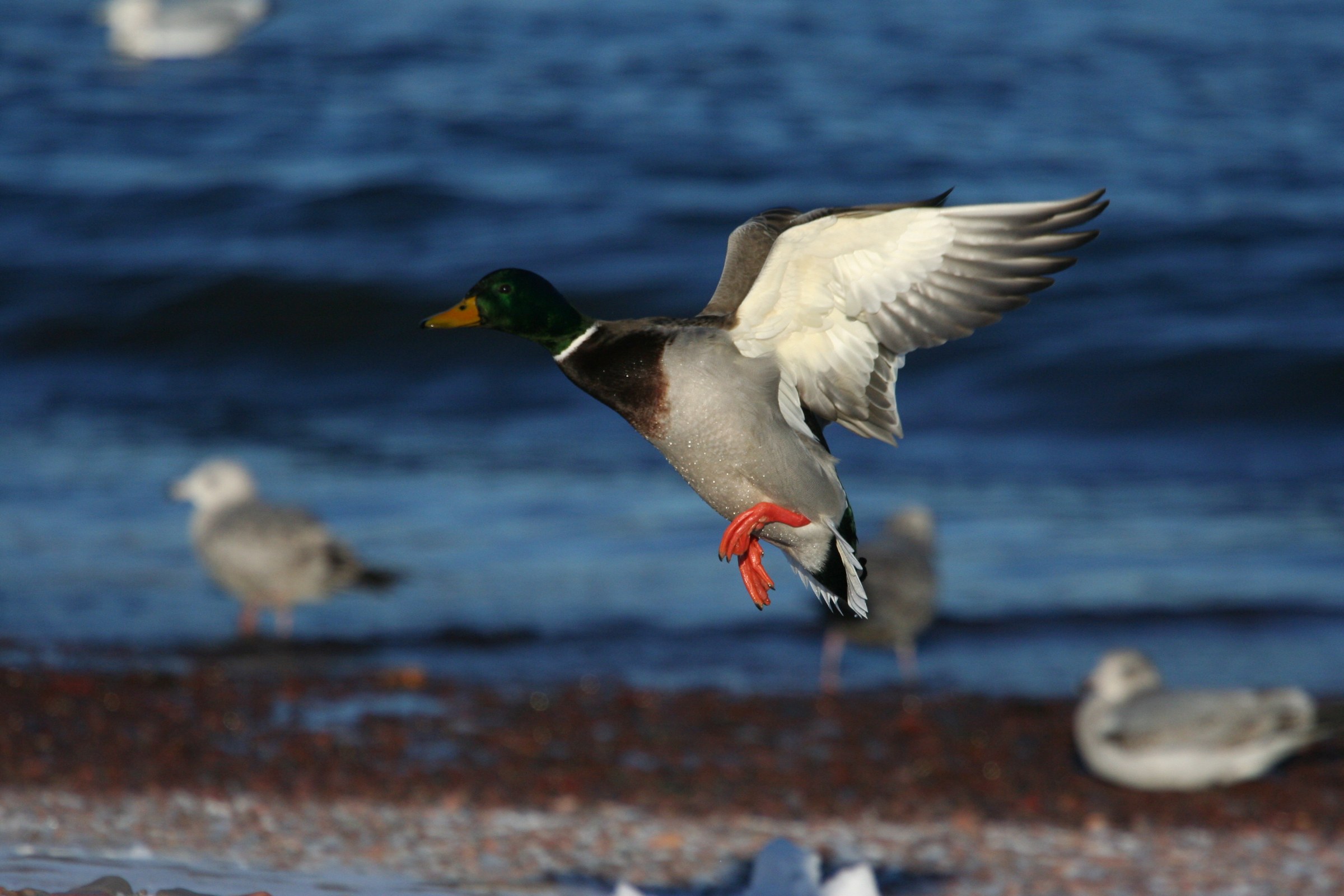
Lead photograph: a male mallard landing above water, photographed by Brynn, CC BY-SA 3.0.

Is there a usual time when mallards become active?
Think in terms of light rather than the clock. In a study of wild mallards wintering in Switzerland and southern Germany, birds were more active during daylight than at night on average, and activity peaked at twilight. The same study found that an individual could shift towards more daytime or more night-time activity over a run of days. It did not identify one hour when all mallards wake.
We observed a relatively constant diel pattern with more activity during daylight than at night and peak activities during twilight.
Sunrise also moves through the year and differs by location. “At dawn” is therefore more useful than saying 5 a.m. or 6 a.m. A quiet bird at one moment may be resting, while another nearby bird is feeding or travelling.
Do ducks sleep all night?
No single uninterrupted night-time sleep period can be assumed for wild mallards. GPS tracking of 97 mallards in four Dutch landscapes found regular flights between daytime roosts and night-time feeding sites at dusk and dawn. A bird returning at sunrise may be going to rest after feeding, rather than waking for the first time.
The movement studies describe activity and travel; they do not establish an eight-hour sleep total, fixed 15–30-minute naps or a universal dawn wake-up for ducks.
How can I recognise a resting duck?
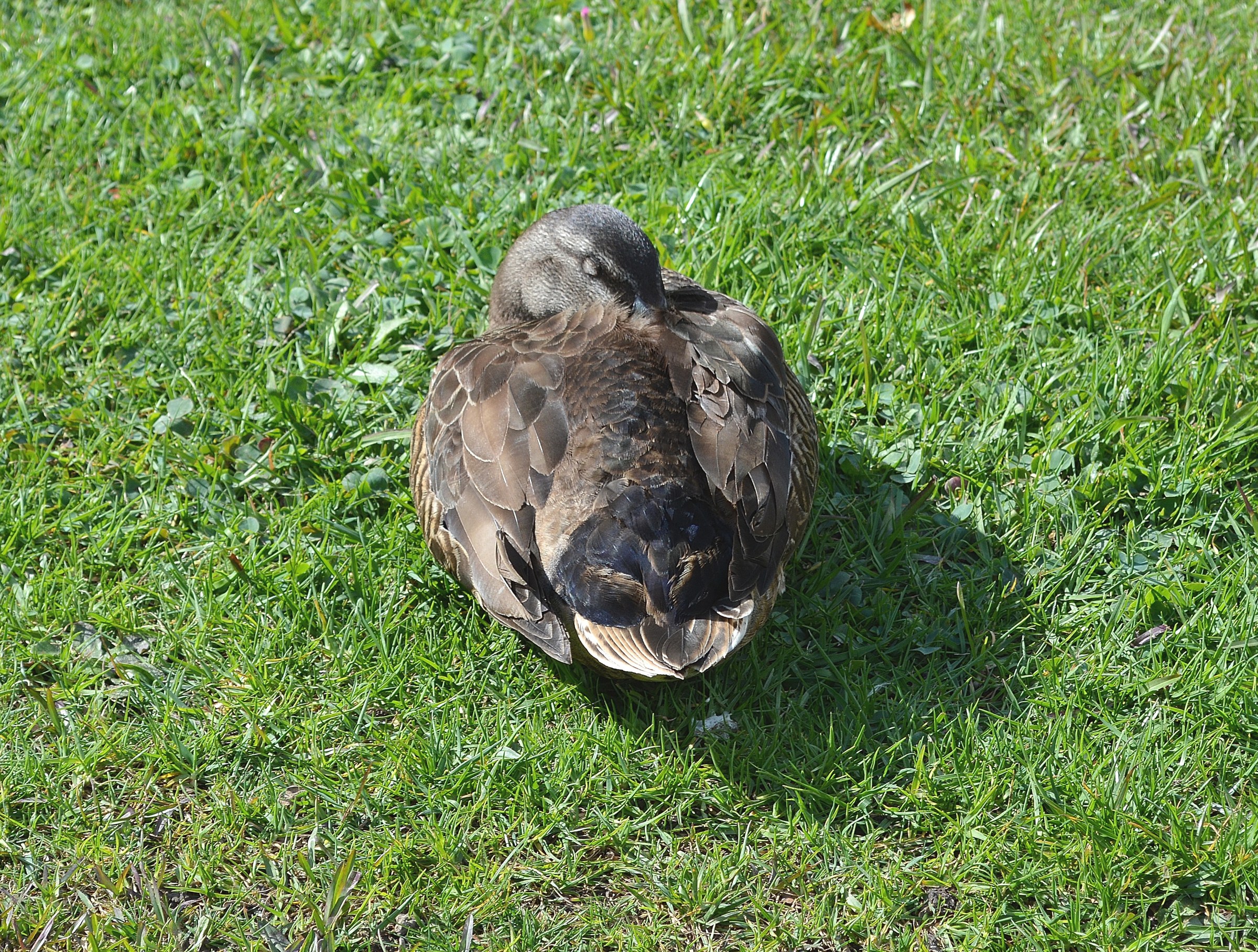
A duck with its head tucked into its feathers may be resting, but posture alone cannot tell you how deeply it is asleep. Some mallards can sleep with one eye open. In an experiment on mallards resting in rows of four, birds at the exposed ends showed more one-sided brain sleep and directed an open eye away from the group. That result does not mean every duck in every flock takes a fixed guard shift.
.jpg)
Make a useful dawn note
Write down local sunrise and whether the first mallards you see are arriving, leaving, feeding or resting. Repeat on several days before calling it a pattern.
When and where should I watch?
Choose a lake, pond or wetland where you have already seen mallards, and arrive before local sunrise. Watch quietly from a path or other public viewing place as light increases. Notice whether birds are leaving, arriving, feeding or resting; each action tells a different story. If mornings are unproductive, try the same place around dusk, when the studies also found movement.
Compare several visits rather than declaring the first bird you see to be the flock’s “wake-up time”. Its route can change with the available roosts and feeding places, and a single visit cannot show what happened overnight. Keep your distance and avoid flushing resting birds for a closer look.
Does this timing apply to all ducks?
No. The studies cited here followed wild mallards in specific European landscapes and seasons. Other duck species, local habitats and domestic birds may have different routines. The useful answer is to start looking around dawn or dusk, then learn the pattern at your own site without assuming that the birds slept until you arrived.
Related reading: Can Ducks See in the Dark? Mallard Night Vision and Colour; Do Ducks Have Teeth? How Their Bills Work.
Sources & further reading
Pius Korner, Annette Sauter, Wolfgang Fiedler and Lukas Jenni, “Variable allocation of activity to daylight and night in the mallard”, Animal Behaviour 115 (2016), checked 27 September 2026 — https://d-nb.info/1220227358/34
Erik Kleyheeg and colleagues, “Movement patterns of a keystone waterbird species are highly predictable from landscape configuration”, Movement Ecology 5 (2017), checked 27 September 2026 — https://link.springer.com/article/10.1186/s40462-016-0092-7
N. C. Rattenborg, S. L. Lima and C. J. Amlaner, “Facultative control of avian unihemispheric sleep under the risk of predation”, Behavioural Brain Research 105 (1999), checked 27 September 2026 — https://pubmed.ncbi.nlm.nih.gov/10563490/