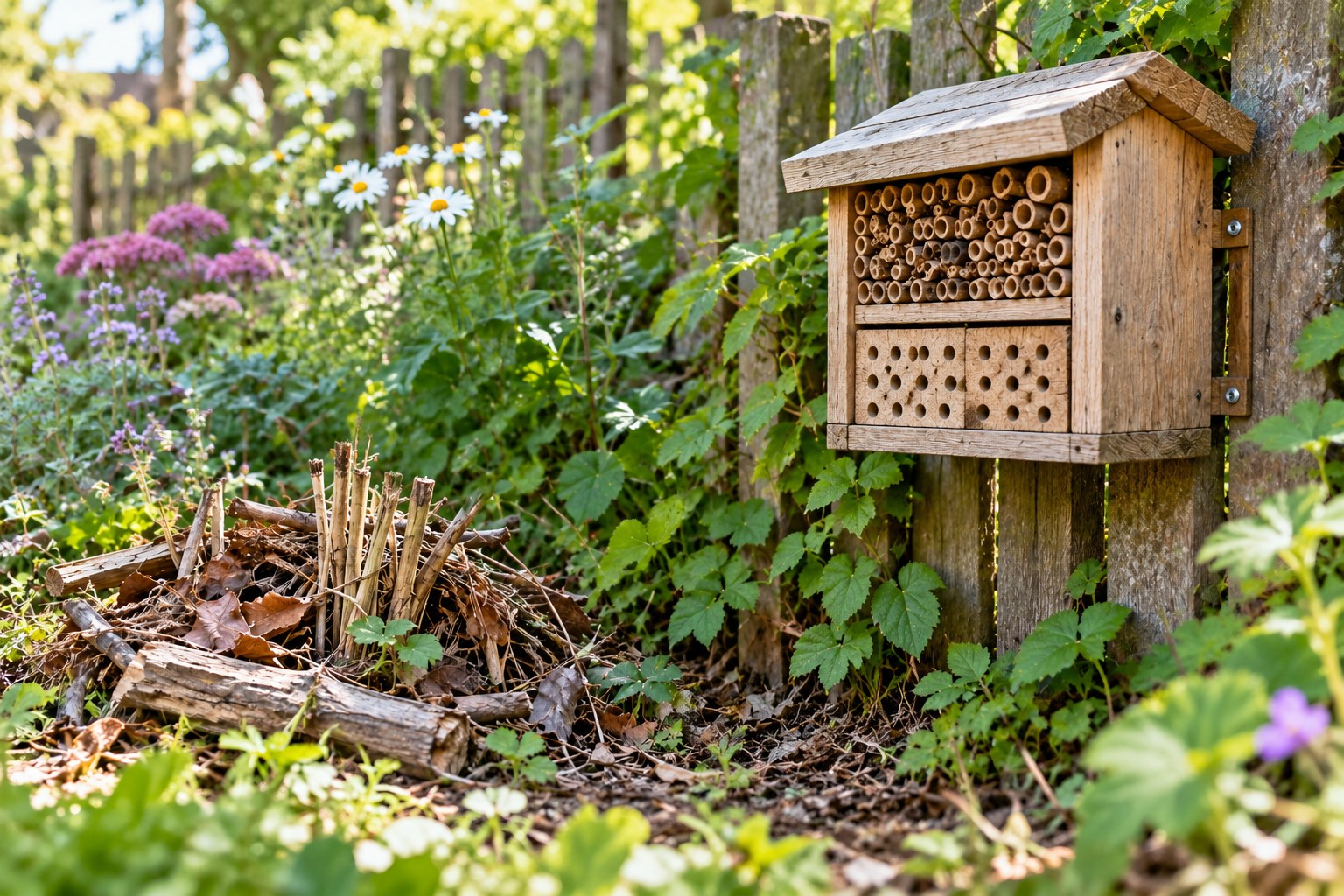
Yes, a bug hotel can give some garden invertebrates a place to shelter or nest. It will not suit every insect, and a crowded, damp bee hotel may cause problems. In a UK garden, the most useful approach is to make a small shelter for the creatures you hope to help, then keep the surrounding garden welcoming too.
What can a bug hotel actually do?
“Bug hotel” covers two quite different things. A ground-level pile of leaves, bark and wood offers hiding places for creatures such as woodlice and beetles. A dry block of drilled timber or hollow stems can provide nesting tunnels for some solitary bees, including mason and leafcutter bees. Most solitary bees nest in the ground, so a row of tubes will not serve them all. The Buglife guide to bee hotels makes this distinction clear.
Nor does a filled nest block prove a conservation benefit. In a three-year study of bee hotels in Toronto, native bees shared the structures with introduced bees and wasps, and the researchers raised concerns about parasites. Those Canadian results cannot be treated as a count of what will happen in a UK garden. They do show why it is better to watch how a hotel is used than to assume every occupied hole is a success.
Which kind should you make?
Start with the space you have. If there is a quiet, shaded corner, leave a modest pile of untreated logs, twigs and dry leaves near the ground. Gaps among the materials offer shelter; you do not need a tall pallet tower. Keep the pile stable and let it remain undisturbed, especially through winter.
If you have a sunny wall or fence, a separate, small nesting block is a clearer choice for tunnel-nesting bees. Keep its tunnels dry. Mixing wet leaf litter into the same box as bee nests makes it harder to give each part suitable conditions. The RHS guide to bug hotels describes the range of dry and slightly damp spaces that different garden invertebrates use.
“The best bug hotels have lots of small spaces in different shapes and sizes and made from different materials.”
How do you make a small bee nesting block?
Choose a piece of untreated, sound wood. Drill a modest number of holes of different widths, roughly 2–10 mm. Make them deep where the timber allows, but do not drill through the back.
Remove rough edges and splinters at each entrance. Add a little roof or overhang to shed rain, and keep the front clear of plants.
Fix the block firmly above the ground on a sheltered, sunny wall or fence, preferably facing south or south-east. It should not swing in the wind.
These details follow Buglife’s guidance for tunnel-nesting solitary bees. A small block is easier to check and replace than a large structure packed with old tubes. If you use hollow stems instead, secure them so they cannot fall out, and keep their backs closed.
Choose the missing habitat first
Before building, look at your garden. A bare patch of soil, flowering plants or an undisturbed leaf pile may be more useful than another nest block. Add one feature you can look after, then see what uses it.
What should you do after putting it up?
Leave occupied tunnels alone through the nesting season and winter. A plug of mud or leaf pieces can mean a bee has sealed a nest; do not prise it open to check. In late spring, once you are confident the occupants have emerged, replace old, used tubes or add fresh holes. If you are unsure whether a tube is still occupied, keep it sheltered in a sunny place where its occupants can emerge rather than throwing it away. Replace a block that becomes rotten or persistently damp.
Watch without expecting a particular species. You might see a bee enter a tunnel, a sealed opening, or other small creatures using the shelter pile. An empty hotel is a prompt to check its position and nearby flowers, not a reason to fill every corner with more hotels.
What helps beyond the hotel?
Leave some dead stems and leaf litter, keep a small patch of soil free of dense planting, and provide flowers at different times of year. Avoid pesticide use around nesting and feeding areas. These choices offer food and natural nesting places alongside any structure you make. If you garden mostly in containers, our guide to wildlife-friendly plants for pots and small gardens can help you choose a manageable flowering display.
Sources & further reading
- Buglife. “How to be the best bee hotel manager”, revised 5 May 2026. Checked 30 September 2026 — Read source
- Royal Horticultural Society. “Make a bug hotel”, undated. Checked 30 September 2026 — Read source
- J. Scott MacIvor and Laurence Packer. “‘Bee Hotels’ as Tools for Native Pollinator Conservation: A Premature Verdict?”, PLOS ONE, 18 March 2015. Checked 30 September 2026 — Read source