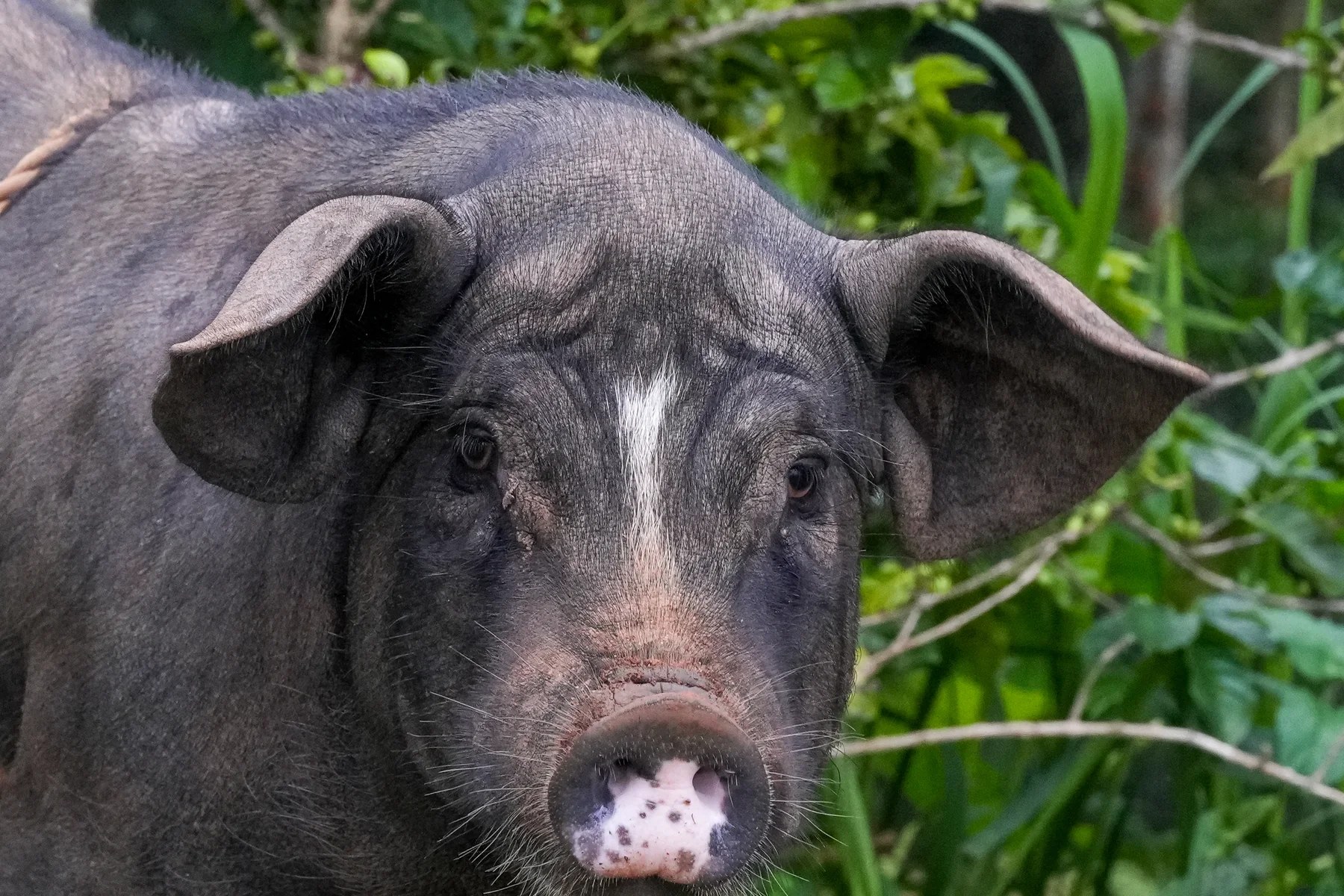
A pig nudging you with its snout has no single meaning. It may be investigating you, looking for food or interaction, or trying to move around you. A gentle touch by itself does not prove affection or a bid for dominance. Watch what happened just before the nudge and what the pig does next. Pigs use their noses extensively to explore and communicate, but a shove alongside threats or biting needs a different response. Merck Veterinary Manual’s account of swine behaviour describes nosing in several social contexts.
Is a nudge a sign of affection?
It can be a bid for social contact, especially when your pig approaches calmly and chooses to stay near you. In a 2024 study of pigs interacting with a familiar person, pigs sometimes voluntarily approached and made contact. The study did not test what an individual nudge means. A gentle nudge could also be exploration or a learned request for food or attention, so one gesture cannot confirm affection. Watch the setting and behaviour over time, and let the pig choose whether to continue the interaction.
How can I read the nudge?
Look at the whole situation rather than assigning one emotion to a snout movement:
Gentle nosing while exploring: the pig may be sniffing you as it would other objects in its surroundings. Allow room for normal rooting and foraging.
Nudging near food or a familiar routine: the pig may have learnt that pushing brings a treat or attention. Notice whether the behaviour changes when food is out of sight.
A hard, repeated shove with threatening behaviour: make space, especially if the pig charges, snaps or tries to bite. Do not assume this is harmless play.
In a 2013 study of gentle nosing between young pigs, the amount of social nosing was unrelated to dominance rank. That study examined pig-to-pig contact, not pet pigs nudging people; it is a reason to avoid reading a human-directed nudge as a dominance test without more evidence.
“Social nosing was largely unrelated to harmful behaviour.”
What should I do when my pig nudges me?
Pause and check the context. If the pig is calm, invite an alternative you have taught, such as standing back, and reward that response rather than giving a treat immediately after a push. Provide safe rooting and foraging opportunities so the pig has another outlet for using its nose. Merck’s miniature-pig management guidance recommends enrichment and reward-based training, and warns that shouting, slapping and other aversive responses can increase fear and aggression.
Try this at the next calm nudge: step clear of the snout, ask for a familiar cue such as “back”, then reward the pig after it moves away. Arrange a suitable rooting activity away from people. If the push feels forceful or threatening, skip training in that moment and move to safety.
When should I be concerned?
A forceful push, charge, snap or bite can injure someone. Keep children away from a pig showing threatening behaviour and do not try to win a pushing contest. The UK Health and Safety Executive warns that even playful pigs can seriously injure children; its guidance is written for agricultural settings, but the precaution is relevant wherever a child and pig meet.
If nudging becomes suddenly forceful or escalates, look for other changes and arrange an assessment with a veterinarian experienced with pigs. Tell the vet if your pig is eating less, limping or reluctant to move: Merck’s guide to miniature-pig diseases identifies loss of appetite and lameness among signs of health problems. These signs do not diagnose the cause of a nudge, but they deserve a health check. For repeated threatening behaviour, ask the vet for help with a safe behaviour plan. Do not diagnose “dominance” or a breed-specific trait from nudging alone.
Does breed tell me what the nudge means?
No breed label can explain an individual nudge on its own. Whether your pig is a miniature pig, a Kunekune or another breed, judge the particular animal and situation. The useful question is not “is this pig trying to be the boss?” but “what is happening around this contact, and is anyone at risk?”
Related reading: What Is “Spoiled Pig Syndrome”? Pet Pig Behaviour Explained; How to Stop a Mini Pig from Squealing: Causes and Calm Responses.
Sources & further reading
Merck Veterinary Manual — Nogues & Creutzinger, “Behavior of Swine” (June 2025): https://www.merckvetmanual.com/behavior/behavior-of-production-animals/behavior-of-swine
Truong, Schmitt & Rault, “On your terms or mine: pigs’ response to imposed gentle tactile contact vs. free form interaction with a familiar human,” Scientific Reports (2024): https://phaidra.vetmeduni.ac.at/api/object/o:3744/download
Camerlink & Turner, “The pig’s nose and its role in dominance relationships and harmful behaviour,” Applied Animal Behaviour Science (May 2013): https://www.sciencedirect.com/science/article/abs/pii/S0168159113000671
Merck Veterinary Manual — Tynes, “Management of Miniature Pet Pigs” (updated September 2024): https://www.merckvetmanual.com/exotic-and-laboratory-animals/miniature-pet-pigs/management-of-miniature-pet-pigs
Merck Veterinary Manual — Tynes, “Diseases of Miniature Pet Pigs” (updated September 2024): https://www.merckvetmanual.com/exotic-and-laboratory-animals/miniature-pet-pigs/diseases-of-miniature-pet-pigs
UK Health and Safety Executive, “Children and public safety” (undated): https://www.hse.gov.uk/agriculture/topics/children.htm
Sources checked 25 September 2026.